
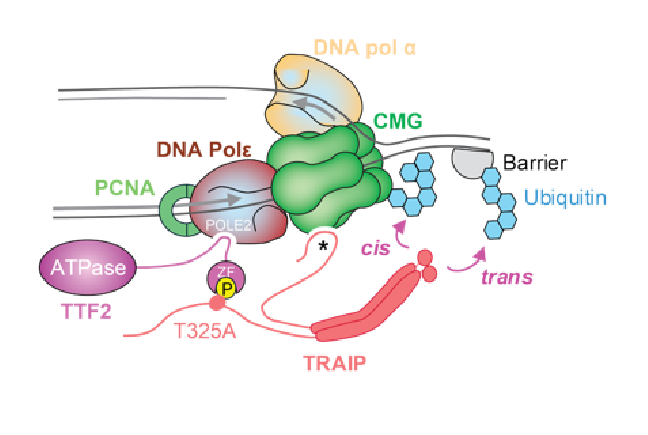
A new paper from the laboratories of David Pellman and Johannes Walter addresses the mechanism of a stress response that enables cells to deal with segments of underreplicated DNA that persist into mitosis. During DNA replication, molecular machines called replisomes copy the genome. These machines often encounter obstacles, including DNA-protein crosslinks, transcription complexes, or difficult-to-replicate regions known as common fragile sites. If replication is incomplete when a cell enters mitosis, unresolved DNA structures can lead to chromosome bridges, breaks, deletions, and genome instability, features frequently associated with cancer.
The new study focuses on TRAIP, an E3 ubiquitin ligase that travels with the replisome. During interphase, TRAIP helps the replisome overcome obstacles in front of the replication fork while avoiding disassembly of the replisome that it travels with. But in mitosis, TRAIP changes roles: it becomes able to ubiquitylate its host replisome’s replicative helicase (CMG), promoting replisome disassembly so that under-replicated DNA can be processed before chromosomes segregate with the least amount of damage to the chromosomes.
The team identified a mechanism for this switch. They found that in mitosis TRAIP’s position on the replisome is reorganized by mitotic phosphorylation (Cyclin B-CDK1) and the mitosis-specific recruitment of an ATPase called TTF2. Phosphorylated TRAIP is bound by the N-terminal zinc finger region of TTF2, while a nearby TTF2 motif binds DNA polymerase ε. Together, these interactions create a molecular bridge that positions TRAIP so it can act on the replisome with which it travels, leading to the stripping of the replisome from stalled forks and triggering a cascade of events leading to fork breakage and repair. Thus, the replisome is reorganized in mitosis as a last chance to prevent catastrophic chromosome missegregation due to covalently linked, partially replicated sister chromatids.