
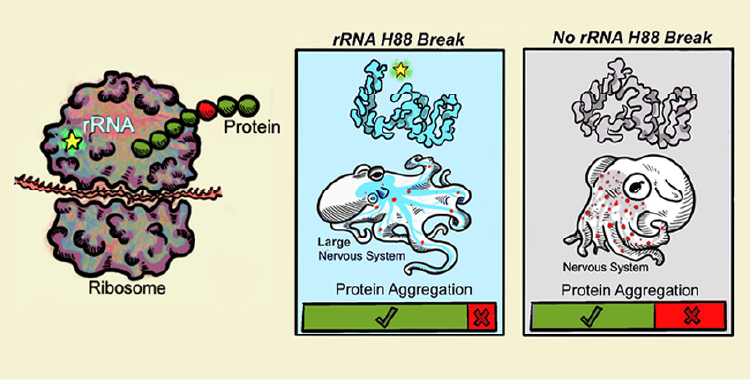
Octopuses exhibit remarkable behavioral complexity, but the molecular adaptations supporting the evolution of their sophisticated nervous systems remain poorly understood. In a new collaborative study, Amy S.Y. Lee and Nicholas Bellono’s (Harvard University) labs identified a previously unknown structural feature in the octopus ribosome that enhances the accuracy of protein synthesis. The researchers discovered a unique break in ribosomal RNA (rRNA), a core component of the ribosome responsible for decoding mRNA into protein, that is absent from all other animal species examined to date. To investigate its function, the team introduced the octopus rRNA break into bacterial ribosomes and found that it increased translational fidelity. Such improved accuracy during protein synthesis can decrease protein misfolding and the formation of toxic protein aggregates. In agreement, octopus tissues contained fewer protein aggregates than squid tissues, suggesting that this ribosomal adaptation promotes proteostasis in vivo. Evolutionary analyses revealed that the rRNA break arose in shallow-water octopus species, which underwent substantial expansion and increased complexity of their nervous systems following their divergence from deep-water relatives approximately 100 million years ago. As neurons are particularly susceptible to the accumulation of misfolded proteins over their long lifespans, enhanced translational fidelity may represent an important adaptation for maintaining neuronal integrity and supporting the evolution of complex neural function. Beyond providing insight into cephalopod evolution, these findings identify a naturally occurring mechanism for improving translation fidelity that could be leveraged to develop therapeutic strategies that improve proteostasis in human neurodegenerative disorders.