
Cells store excess fat in specialized organelles called lipid droplets (LDs), which function as dynamic reservoirs of energy and metabolic building blocks. Unlike most organelles, LDs are surrounded by a phospholipid monolayer rather than a bilayer membrane and support a specialized proteome enriched in enzymes that regulate lipid synthesis and mobilization. Many LD proteins originate in the endoplasmic reticulum (ER) membrane, where they insert co-translationally before trafficking to LDs and accumulating on the monolayer surface. Mislocalization of such proteins, including HSD17B13 and PNPLA3, has been linked to metabolic dysfunction-associated steatotic liver disease (MASLD). However, the mechanisms that govern trafficking and selective accumulation of ER membrane proteins on the LD monolayer have remained poorly understood.
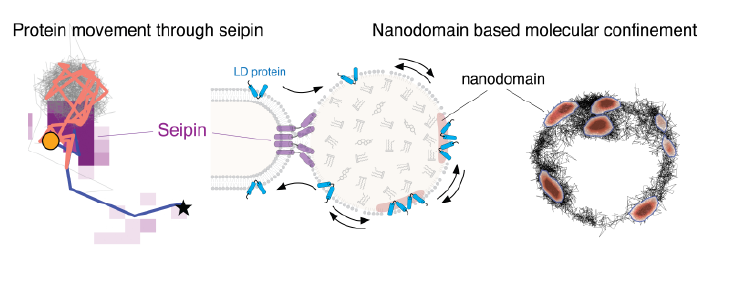
In a recent work, Mizrak et al. combined single-molecule tracking with MINFLUX nanoscopy and HILO fluorescence microscopy to directly visualize how individual proteins move between the ER and LDs in living cells. In collaboration with Farese & Walther Lab at Sloan Kettering Institute, authors analyzed single proteins trajectories rather than population averages, and uncovered transient and heterogeneous behaviors that are otherwise invisible using conventional imaging approaches. The work revealed that LD-targeted proteins do not simply diffuse freely onto lipid droplets. Instead, they become transiently trapped within nanoscale lipid-protein domains enriched in neutral lipids. These nanodomains reshape local protein motion and kinetically retain proteins on the LD monolayer, promoting their selective accumulation over time. Single-molecule trajectories further revealed bidirectional protein exchange through seipin-containing ER–LD membrane bridges, providing direct evidence that proteins can laterally move between connected organelles. Together, these findings establish membrane nanodomains and membrane bridges as cooperative mechanisms that govern selective protein targeting to cellular fat stores.